Thirty-three million people. One in 450 is a Christian.
The Chittagong Division is the southeastern corner of Bangladesh — more people than Texas, in an area the size of Maryland. It is one of the least-reached places on earth. It is also the place God has called us to.
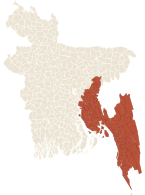
Half the population of America, in a country smaller than Georgia.
Bangladesh sits in the delta where the great rivers of the Himalayas meet the sea, wedged between India and Myanmar. Around 170 million people — half the population of the United States — live in a country smaller than the state of Georgia. It is divided into eight divisions, which work much like U.S. states.
Chittagong is the southeastern one: a long coastal run from the port city of Chattogram down to the beaches of Cox's Bazar, rising inland to the forested ridges of the Chittagong Hill Tracts. If you have ever prayed for a place you could picture, picture this one — fishing boats on brown rivers, tea-stall towns, garment factories, rice paddies, and hills that hold peoples found nowhere else on earth.
You'll see two spellings: the government officially renamed the city and division Chattogram in 2018, closer to the Bangla. Like most of the world, we still say Chittagong.
- Chattogram is Bangladesh's second city — 3.2 million people in the city proper.
- Its port handles roughly 90% of Bangladesh's seaborne trade.
- Cox's Bazar runs 120 unbroken kilometers — among the longest natural beaches on earth.
- This coast bears the storms: the 1991 cyclone killed at least 138,000 people here in a single night.
Two hundred fifteen peoples. Most have never heard.
The 2022 census counts the division at 90% Muslim, with Hindu and Buddhist minorities many times larger than the church.
Picture 450 of your neighbors — a packed church sanctuary, twice over. One of them is a Christian. That single clay dot is the church in the Chittagong Division.
Bengali Muslims
About 135 million Bengali Muslims live in Bangladesh — Operation World calls the Bengali people the largest unreached people group in the world. In the division they are the farmers, shopkeepers, and factory workers next door.
Joshua Project profileThe Rohingya
Close to a million Rohingya refugees live in the camps outside Cox's Bazar — UNHCR calls Kutupalong the largest refugee settlement in the world. On Bangladesh's census, not one reported themselves a Christian.
Joshua Project profilePeoples of the Hill Tracts
The hills hold more than a dozen indigenous peoples — the Chakma (539,000, Bangladesh's largest Buddhist people), the Marma (247,000), the Tripura (151,000), and smaller groups with their own languages and their own histories.
All Bangladesh people groups“Unreached” is not a slogan — it is a measurement. Joshua Project counts a people group as unreached when followers of Jesus are so few — typically under 2% — that the group cannot carry the gospel to its own people without help from outside.
The Bible has spoken Bengali for over two hundred years.
In 1801, William Carey and his colleagues at Serampore printed the first Bengali New Testament — one of the founding acts of the modern missions movement that American churches grew up on. Two centuries later, Operation World still lists Bangladesh among the least-reached nations on earth: for all the years of faithful labor since Carey, a breakthrough among Bengali Muslims has not yet come.
The 2022 census counts 0.30% of Bangladesh as Christian. Joshua Project reckons that 99 of every 100 Bangladeshis live inside an unreached people group. This is not a place with a church on every corner and a gospel witness down the street. For most people in the Chittagong Division, there is no believing friend, no nearby congregation — no one to ask.
Bangladeshis reaching Bangladesh.
The church in the division is small, but it is real — strongest among the hill peoples, where about 3% of the Hill Tracts identifies as Christian, and the Marma received a New Testament in their own language just a few years ago. God has not left this place without a witness.
We believe Bangladeshis are uniquely equipped to reach Bangladesh — they speak the languages, they understand the cultures, and they are already there. So we equip local believers: pastoral and discipleship training for more than 250 pastors and church leaders across the region, support for Bangladeshi teachers and evangelists, and humanitarian help in a division that bears the storms.
The need is vast. The workers are few. But the harvest belongs to the Lord — and he is raising up laborers from the rice paddies and hill villages themselves.
Figures on this page come from the 2022 Bangladesh census and from the missions researchers our own team relies on. Go deeper:
Those who have never been told of him will see, and those who have never heard will understand.Romans 15:21 · ESV